
A Vow of Holiness — When the Mist Rises —The Breath Between Waters
Texts: Jeremiah 35:5–11 — The Rechabites’ Vow
Bereshit / Genesis 2:4–17 — The Breath and the Garden
Four Voices
Jeremiah 35:5-11 A Vow of Holiness
5 I set cups and jugs of wine before them and invited them to have a drink, 6 but they refused. “No,” they said, “we don’t drink wine, because our ancestor Jehonadab son of Recab gave us this command: ‘You and your descendants must never drink wine. 7 And do not build houses or plant crops or vineyards, but always live in tents. If you follow these commands, you will live long, good lives in the land.’ 8 So we have obeyed him in all these things. We have never had a drink of wine to this day, nor have our wives, our sons, or our daughters. 9 We haven’t built houses or owned vineyards or farms or planted crops. 10 We have lived in tents and have fully obeyed all the commands of Jehonadab, our ancestor. 11 But when King Nebuchadnezzar of Babylon attacked this country, we were afraid of the Babylonian and Syrian armies. So we decided to move to Jerusalem. That is why we are here.”
Chiastic Structure
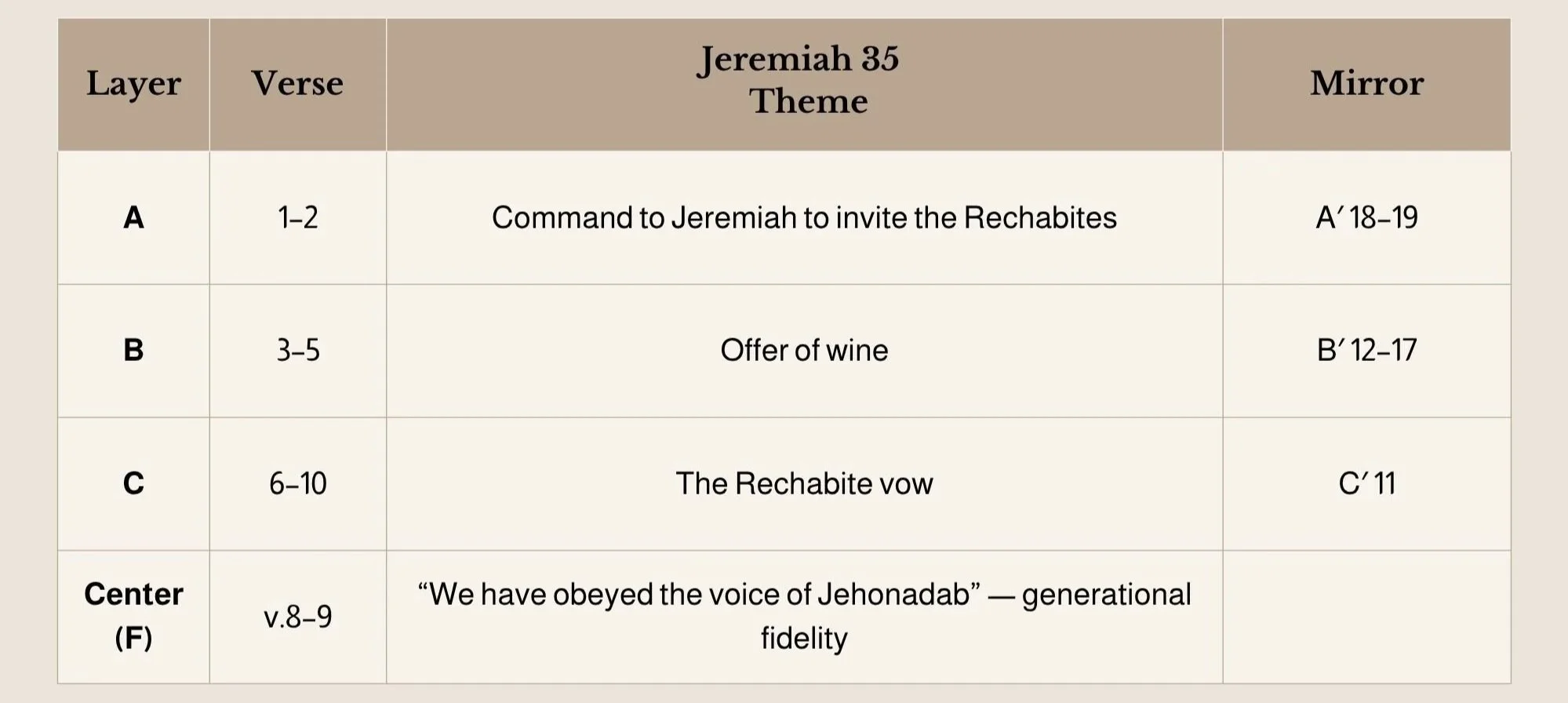
On a mystical level, the wine refused and the mist that rose are the same act of faith. Both represent breath-control — the sacred art of not consuming too soon.
In Eden, the test was fruit.
In Jeremiah, the test is wine.
In both, desire meets discipline, and life flows from restraint.
The Rechabites embody teshuvah without rebellion — a preemptive repentance, living always one step before failure.
Old Testament
Bereshit (Genesis) Chapter 2
4 The preceding account is the chronicle of how everything in heaven and earth began to function at its proper time, everything having been created on the day that God made earth and heaven, i.e., on the first day.
5 On the sixth day, no tree of the field was yet on earth, nor had any grass of the field yet sprouted, because God had not brought rain upon the earth, for there was no human to work the ground and appreciate the value of rain.
6 So God made a mist rise up from the earth and water the entire surface of the ground.
7 Using this mist, God formed the human out of dust of the ground by “kneading” the dust into a body. God blew into his nostrils a soul of life, and the human became a living being.
8 God planted a garden to serve as humanity’s habitat in the eastern part of Eden, and He placed there the human whom He had formed.
9 God caused the ground of the Garden of Eden to give forth especially lush growth: every tree that is of pleasing appearance and good for food. The Tree of Life, whose fruit imparted immortality to whoever eats it, was in the center of the garden, as was the Tree of Knowledge of good and evil.
Chiastic Structure

In this design, Genesis 2 unfolds like a temple blueprint:
The outer courts: heaven and earth formed.
The inner court: mist rising and Word descending.
The Holy of Holies: God breathing life into dust.
The chiastic rhythm invites us to see that creation is a covenant of breath — each gift met by restraint, each freedom balanced by reverence.
Where Western readers often see sequence (what happened next), the Hebrew mind sees symmetry (how heaven mirrors earth).
Pattern: Each vow — human or divine — protects life until external pressure tempts disobedience. The Rechabites preserved holiness under siege; Adam lost it in paradise.
PARDES Reflection
Peshat (Literal) — The Rechabites obey their ancestor’s command to abstain from wine and permanent settlement. Adam is formed from dust and charged to guard Eden. Both narratives elevate obedience as the condition of life.
Remez (Hint) — Both stories suggest a spiritual ecology: restraint preserves harmony. The Rechabites’ refusal mirrors the earth’s mist — self-controlled, rising upward, asking nothing but sustaining everything.
Drash (Interpretive) — The Rechabites become a prophetic mirror to Jerusalem: their holiness exposes Judah’s compromise. Likewise, Adam’s failure exposes humanity’s tendency to overreach. Holiness is not withdrawal from the world but dwelling lightly within it.
Sod (Mystical) — The mist of Genesis and the vow of Jeremiah are two aspects of the same hidden covenant — the ascent of consciousness. In the Zohar’s language, the ’ed is Shekhinah rising to meet Tiferet.
Word Studies
1. אֵד (*’ed*) – “Mist” (Genesis 2:6): Literally “vapor rising.” Rabbinic sources say the *’ed* ascended as the earth’s prayer. Creation participates in its own blessing. Holiness starts with ascent — not possession.
2. נֵדֶר (*neder*) – “Vow” (Jeremiah 35, thematic root): Derived from a root meaning to separate or set apart. A vow is a chosen boundary that sanctifies ordinary life.
3. אָדָם (*adam*) and אֲדָמָה (*adamah*): Humanity (*adam*) comes from soil (*adamah*). The Rechabites’ tent-dwelling honors this truth — they remain close to the ground, unencumbered by empire’s architecture.
