
When the Cry Becomes a Name
Main Text: Matthew 6:5–15
Torah Parallel: Exodus 2:23–25; 3:1–15
New Testament
Matthew 6:5-15
Teaching about Prayer and Fasting
5 “When you pray, don’t be like the hypocrites who love to pray publicly on street corners and in the synagogues where everyone can see them. I tell you the truth, that is all the reward they will ever get. 6 But when you pray, go away by yourself, shut the door behind you, and pray to your Father in private. Then your Father, who sees everything, will reward you.
7 “When you pray, don’t babble on and on as the Gentiles do. They think their prayers are answered merely by repeating their words again and again. 8 Don’t be like them, for your Father knows exactly what you need even before you ask him! 9 Pray like this:
Our Father in heaven,
may your name be kept holy.
10
May your Kingdom come soon.
May your will be done on earth,
as it is in heaven.
11
Give us today the food we need,
12
and forgive us our sins,
as we have forgiven those who sin against us.
13
And don’t let us yield to temptation,
but rescue us from the evil one.
14 “If you forgive those who sin against you, your heavenly Father will forgive you. 15 But if you refuse to forgive others, your Father will not forgive your sins.
Old Testament
Shemot (Exodus) Chapter 2
23 It was during those many years that the king of Egypt died. The Israelites moaned on account of the work and cried out. Their pleas from the work rose up before God.
24 God heard their anguished groan, and God recalled His covenant with Abraham, Isaac, and Jacob.
25 God looked upon the Israelites, and God took note.
Shemot (Exodus) Chapter 3
1 Moses was tending the flocks of his father-in-law Jethro, ruler of Midian. Moses guided the flock far into the desert and came to the mountain of God, Mount Horeb.
2 An angel of God appeared to him in the heart of a blazing fire from the midst of a thorn bush. He saw that the bush was on fire, but the bush was not being consumed.
3 Moses said, “Let me turn away and behold this remarkable sight. Why doesn’t the bush burn?”
4 God saw that he had turned aside to look. God called to him from the midst of the bush, saying, “Moses, Moses!” He replied, “Here I am.”
5 God said, “Come no nearer. Remove your shoes from your feet, for the place on which you are standing is holy ground.”
6 God said, “I am the God of your father, the God of Abraham, the God of Isaac, and the God of Jacob.” Moses hid his face, since he was afraid to look at God.
7 God said, “I have indeed seen the affliction of My people in Egypt. I have heard their outcry caused by their taskmasters, for I am aware of their pains.
8 I have come down to rescue them from the hands of the Egyptians, and to take them up from that land to a good and ample land, to a land flowing with goats’ milk and date- and fig-honey, the region of the Canaanites, the Hittites, the Amorites, the Perizites, the Hivites, and the Jebusites.
9 And now, the outcry of the Israelites has indeed reached Me, and I have also seen the oppression to which the Egyptians are subjecting them.
10 Now go. I will send you to Pharaoh. You will take My people, the Israelites, out of Egypt.”
11 Moses said to God, “Who am I that I should go to Pharaoh and take the Israelites out of Egypt?”
12 God replied, “Do not worry, for I will be with you. This is your sign that I have sent you. When you take the people out of Egypt, you will all serve God on this mountain.”
13 Moses said to God, “I am going to come to the Israelites and say to them, ‘The God of your forefathers has sent me to you.’ They will ask me, ‘What is His Name?’ What should I tell them?”
14 God said to Moses, “I will be just as I will be.” God then said, “You must say to the Israelites, ‘“I will be” sent me to you.’”
15 God further said to Moses, “So must you say to the Israelites: ‘God, the God of your forefathers—the God of Abraham, the God of Isaac, and the God of Jacob—has sent me to you.’ This is My proper Name, but its pronunciation is to be concealed. This is how I am to be recalled for all generations.”
CHIASTIC STRUCTURE
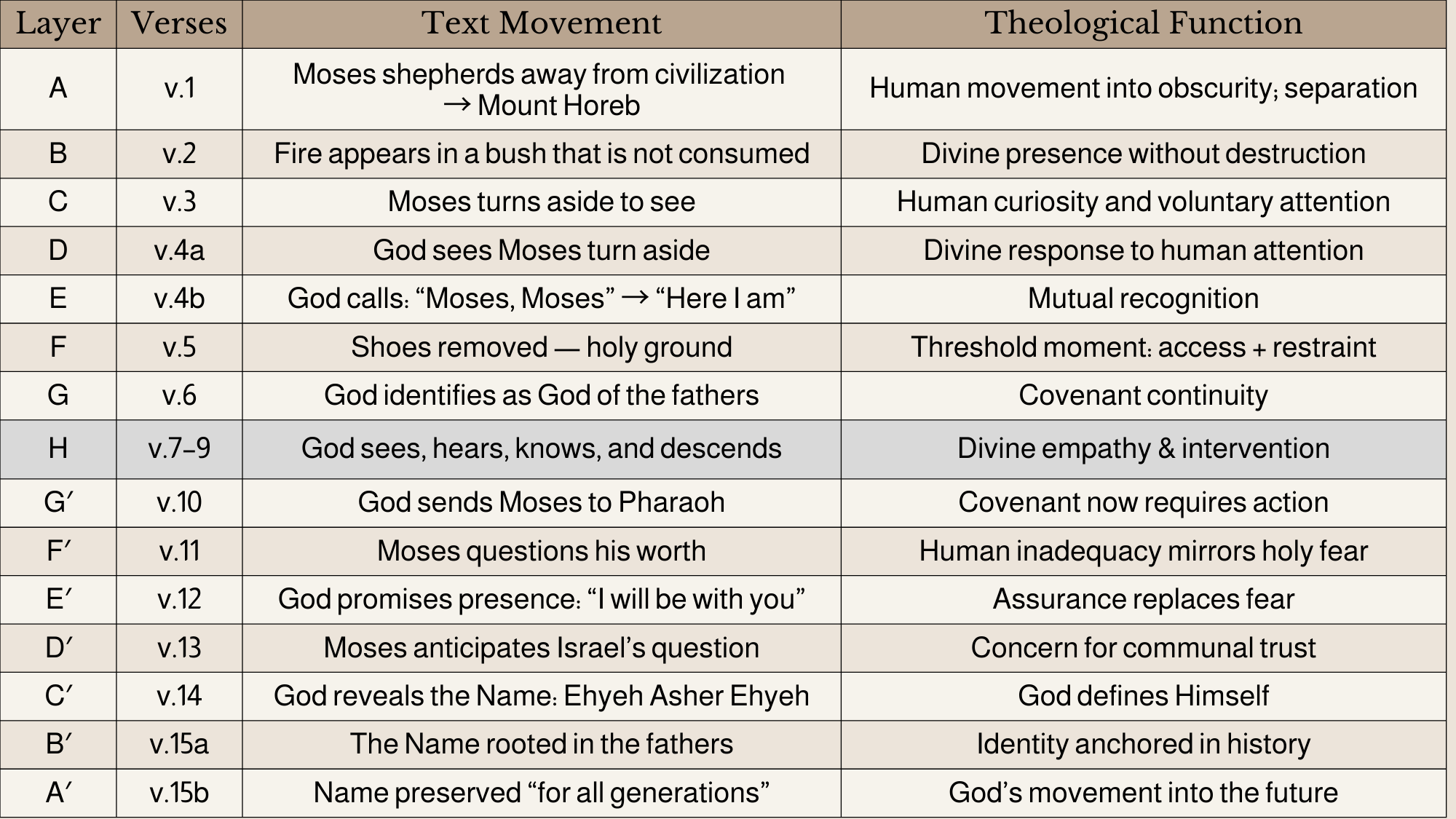
Center of Gravity (H) — vv.7–9
“I have indeed seen… I have heard… I know their pains… I have come down…”
This is the emotional and theological core of the passage.
God does not begin with command.
God begins with attention.
Revelation is grounded in suffering heard, not power displayed.
PARDES Reflection
Peshat (Plain)
God hears suffering. Jesus teaches prayer away from performance.
Remez (Hint)
The burning bush mirrors the praying person: aflame, not consumed.
Drash (Interpretive)
True prayer resists empire by refusing both despair and domination.
Sod (Mystical)
The Name Ehyeh becomes flesh in a people who pray without pretense.
Teaching Takeaways
Prayer is not persuasion; it is participation.
God’s Name is not a password; it is presence.
Daily bread is a protest against fear.
Forgiveness is proof you’ve left Egypt
Hebrew & Greek Word Windows
צעקה (Tze‘akah) – “Outcry” (Exod. 2:23)
Not polite prayer. Legal distress. The sound of injustice.אהיה (Ehyeh) – “I Will Be” (Exod. 3:14)
God defines Himself as ongoing accompaniment.ἄρτος ἐπιούσιος (artos epiousios) – “Daily bread” (Matt. 6:11)
Bread sufficient for the coming day. Freedom from anxiety and hoarding.
