
Abba in the Courtroom
Main Text: Romans 8:12–17, 26–27
Torah Parallel: Genesis 44:31–34; 45:1–2
Theme: Adoption is not a legal label—it's Spirit-powered substitution that turns slaves into sons and groans into prayer.
New Testament
Rom. 8:12-17, 26-27
The Spirit Affirms Our Adoption
12 Therefore, dear brothers and sisters, you have no obligation to do what your sinful nature urges you to do. 13 For if you live by its dictates, you will die. But if through the power of the Spirit you put to death the deeds of your sinful nature, you will live. 14 For all who are led by the Spirit of God are children of God.
15 So you have not received a spirit that makes you fearful slaves. Instead, you received God’s Spirit when he adopted you as his own children. Now we call him, “Abba, Father.” 16 For his Spirit joins with our spirit to affirm that we are God’s children. 17 And since we are his children, we are his heirs. In fact, together with Christ we are heirs of God’s glory. But if we are to share his glory, we must also share his suffering.
26 And the Holy Spirit helps us in our weakness. For example, we don’t know what God wants us to pray for. But the Holy Spirit prays for us with groanings that cannot be expressed in words. 27 And the Father who knows all hearts knows what the Spirit is saying, for the Spirit pleads for us believers in harmony with God’s own will.
Old Testament
Bereshit (Genesis) Chapter 44
31 when he sees that the lad is not there, he will die: your servants will have brought your servant our father’s white-haired head down to the grave in grief.
32 I am speaking, rather than one of my other brothers, because I, your servant, guaranteed to return the lad to my father, saying, ‘If I do not bring him back to you, I will have sinned against my father for all time.’
33 So now, please let me, your servant, remain as a slave to my lord in place of the lad, and let the lad go back up to Canaan with his brothers.
34 For how can I go up there to my father if the lad is not with me? Let me not be forced to witness the calamity that would befall my father!”
Bereshit (Genesis) Chapter 45
1 Joseph could not bear to have his brothers shamed in the presence of all the people standing around him. So he exclaimed, “Have everyone leave my presence!” Thus, no man was left standing near Joseph when he made himself known to his brothers.
2 He broke out into loud weeping; the Egyptians heard it, and word spread until the members of Pharaoh’s household heard about it, as well.
CHIASTIC CENTER
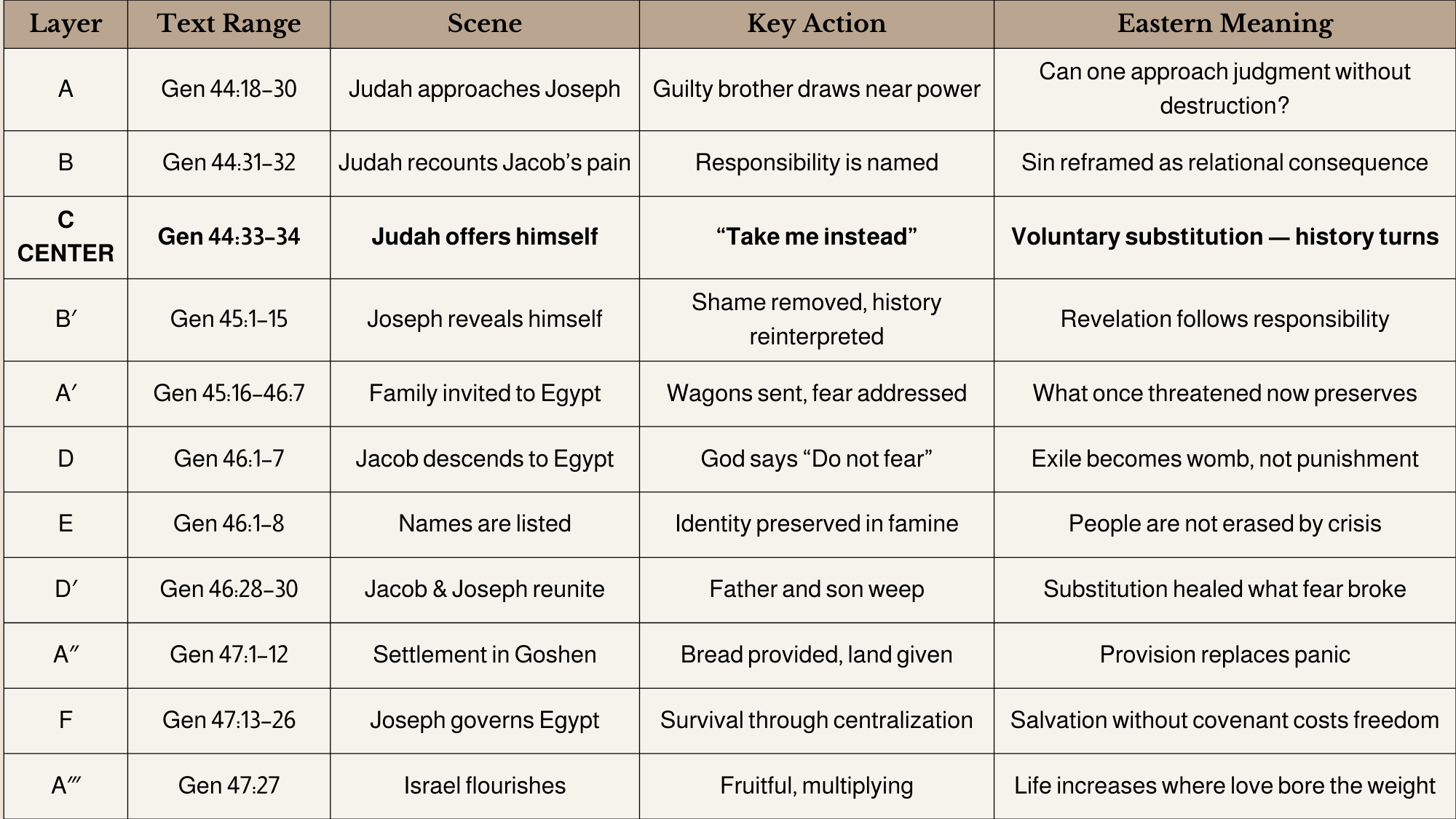
This chiastic center teaches the pattern later fulfilled in Jesus Christ:
approach judgment
assume responsibility
offer oneself
revelation follows
family restored
life multiplies
The New Testament inherits this structure. It does not invent it.
The New Testament inherits this structure.
It does not invent it.
PARDES — four layers, one heartbeat
Peshat (Plain)
Paul tells believers: the Spirit breaks the old master (flesh/fear) and gives a new family identity (adoption).
Judah pleads: if Benjamin doesn’t return, Jacob dies—so Judah offers himself.
Remez (Hints)
Judah’s “take me instead” hints at the later gospel logic:
substitution precedes revelation
love absorbs shame
a brother stands in the gap
Joseph reveals himself after substitution appears.
Drash (Sermonic / Ethical)
End-of-year test:
Where did you live this year as a fearful slave—overworking, overcontrolling, people-pleasing, hiding?
Where did the Spirit lead you into sonship—truth-telling, repentance, repair, courage?
And here’s the Judah question:
“Who are you willing to lose status for… so they can live?”
Sod (Mystical / Deep)
There is a holy mystery here:
Judah offers slavery so another can go free.
Joseph weeps because the hard shell of history cracks.
Paul says the Spirit prays inside you at the level of pre-language—where the truest you lives.
So adoption is not merely “God likes you.”
Adoption is God relocating your inner voice.
The Spirit moves in and you start calling God “Abba” from a place you didn’t even know existed.
Discussion
Where did fear make you act like a slave this year—even while you were “saved”?
What would it look like for the Spirit to lead you in one specific habit starting this week?
Who is your “Benjamin”—the person you’d usually sacrifice to keep your comfort?
Why does substitution trigger revelation in Genesis 45?
What is one “groaning” you’ve carried that you now believe God can translate?
WORD STUDY
1. Abba (Ἀββᾶ) — “Father” as intimacy + access
Not baby talk, not sentimental.
This is family courtroom language: “I have standing here. I belong here.”
Abba is what a child says when they stop negotiating.
No more “Do I qualify?”
Now it’s “Father.”
2. Adoption (υἱοθεσία, huiothesia) — “placement as a son”
Not just affection—status.
In Roman law, adoption meant:
a new household
a new inheritance
a new name
old debts cancelled (socially, legally)
So when Paul says “adoption,” he’s describing a Spirit-act that re-assigns your identity.
3. Led (ἄγω, implied in “led by the Spirit”) — guided like a people in Exodus
Not “inspired sometimes.”
Led like Israel was led—day by day—out of slave-mind.
If the Spirit is leading, something is leaving.
4. Groanings (στεναγμοῖς, stenagmois) — wordless pressure-sounds
This is the sound you make when:
pain exceeds vocabulary
desire exceeds clarity
you can’t even locate what’s wrong, you just know it’s wrong
Paul says: God does not reject that sound.
God translates it.
5. Torah Key: “In place of” (תַּחַת, tachat — conceptually in Gen 44:33)
Judah: “Let me remain… in place of the lad.”
That phrase is the grammar of substitution all over Torah:
ram instead of Isaac
firstborn redeemed instead of death
offerings instead of the worshiper’s life
Judah becomes the offering.
